
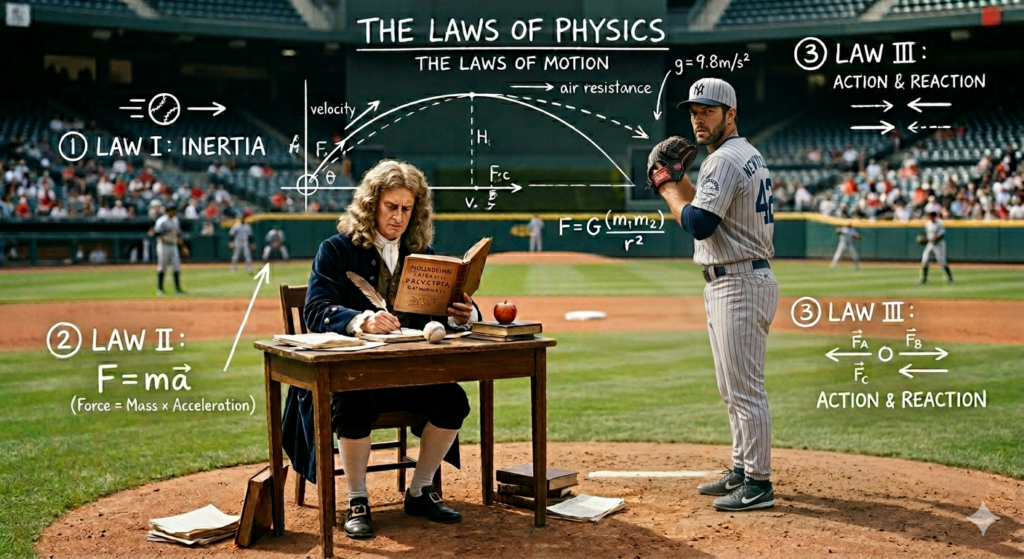
Inertia, by definition, is the tendency for an object to resist changes to its current state of motion. A body at rest will stay in rest. A body in motion will stay in motion, unless acted upon by an external force. When we throw a baseball, we don’t have an external force that “pushes” us into motion. The forces that propel us come from within. They’re brought to life through our interactions with our external environment (e.g. the ground). There is a work cost to bring these forces to life.
That work cost is what this section is about.
The beginning part of the delivery is where we arguably see more style than anywhere else. The height of our lead leg, the depth of our back leg, or how much we turn our hips are all specifically catered to what we like and what works best for us. Some of these things are influenced by structure (e.g. hip external vs. internal rotation bias). Others are ingrained ways we prefer to move (e.g. vertical vs. horizontal force preference). The only rule is it has to work for us. But there are a few things all of us do more similarly than differently. This section isn’t just about style. It’s about uncovering the substance that allows our style to emerge.
To do this, we have to appreciate the interplay between all three planes of motion when we organize our body to make a throw:
- Transverse (pelvic counter rotation, back leg internal rotation)
- Frontal (pelvic tilt, hip abduction)
- Sagittal (hip hinge/flexion, knee flexion, trunk extension)
Once we move on to one leg, we’re never operating in just one plane of motion. We’re balancing all three at the same time. What we do in one plane of motion will subsequently influence what we do in another. Rotation into your back leg depends on how much hip flexion you have at the hip. But rotation into your back leg can also depend on your internal rotation capacity. You can only rotate as far as your body allows. As a result, we have to take into account both structural/hardware preferences and software/movement-based preferences when evaluating substance vs. style.
In some cases, those preferences will tell us about what we should move more like. The guy who loves extension-based activities shouldn’t be so hyper focused on creating a ton of hip flexion in his loading pattern. But in other cases, the extension-based mover needs a touch of hip flexion to find balance. We all need our fruits and vegetables to find movement efficiency.
…
My search for movement efficiency goes back to when I was eleven years old. My introduction to pitching included drill work where I learned how to find a balance point. When I later on learned pitchers never really get to a true “balance point,” I rebelled and started trying to move faster. I liked moving faster, but I also found the faster I moved the more I started to lose my back leg. Finding this sweet spot between tension and tempo is what I spent most of my college career trying to figure out. I knew I needed to move fast, but I also learned there was substance behind the balance work I did growing up.
When I started to throw again, I knew I had a lot more tools and drills at my disposal. I didn’t want to get too narrow too early, so I picked out a variety of drills that covered opposing ends of a few different spectrums. If I did a drill with less movement, I balanced it out by picking a drill with more movement. It’s a lot easier to find what you like from the buffet if you open it up at the beginning.
Some of the drills/exercises I tried to start included:
- Back foot elevated
- Wide base no stride
- Wide base with stride (off mound)
- Single/double hops
- Walking windup
- Walk in to balance
- RDL throw
- RDL throw with multiple leg lifts
- Walk in throw
- QB drop backs
The more I tried, the more I started to learn about my body. Trying to pre-set tension in my lower half with less movement had a short shelf life – wide base no stride, back foot elevated throws. They’d work when I really needed to exaggerate something (back knee valgus was a common one). But long term, they didn’t help sync up my delivery in a way that felt really athletic. I could only do so many back foot elevated throws before I felt like my back leg was getting stuck in quicksand. I decided to keep these in my back pocket as back up options, not daily progressions. Balance drills fell under this category. I liked the feeling of being balanced and having tension in my back leg, but the break in momentum made it tough to rotate.
This brings me to drill work with more movement: Hops, QB drop backs, rhythm based throws (walk ins, walking windups). When I was at the Florida Baseball ARMory, we did a lot of throwing drills where guys would have to hop, change direction, and accept force on one leg. These forces created really “loud” or noticeable feedback within the body, something you need to accelerate the learning curve on a new change. You can talk to a kid all day long about how he’s too deep into his back leg to rotate. It’s much more efficient to make him hop twice forward and make a throw. The body no longer has time or ability to do the bad pattern. The forces your body is dealing with demand you do something different – the key to making movement changes that stick.
While I still love to program single/double leg hops, I learned they’re not my personal favorite. I’m more of a ground-based, terrestrial type mover. I love hip flexion and hip external rotation. I really struggle with hip extension based patterns – sprinting, jumping, changing direction. Trying to sync up and make a throw after hopping twice on my back leg feels like chaos. I move faster, but I don’t feel like I move better. Good drills, but not good drills for me.
This pushed me into the direction of more rhythm-based movements. Anything where I felt like I was moving, but in control of how I was moving, was something my body liked. Walking windups were no longer my strategy to simply get away from a balance point. They were how I learned how to find that sweet spot between tension and tempo in my back leg.
I also decided to get a little more creative with them. I experimented walking into leg lift from as many different directions as possible – directly forwards, backwards, arm/glove side, one step, two steps, at a slight angle. The ones I ended up enjoying the most were directly forwards (like making a straight line towards the catcher) and backwards. I do both directions daily off the mound to warm up.
Working on a straight line towards the catcher wasn’t just something I did for directional purposes. It helped create some rotation into my back leg. Being someone who sits in hip external rotation at rest – especially on my back leg – I need some hip internal rotation to get back to neutral in regard to my back hip/femur. I never find true hip on femur internal rotation. But I also don’t really need it. It’s one thing to internally rotate. It’s another to be in internal rotation.
This ended up being a really big lower half key for myself. Feeling some rotation into my back leg at leg lift created some space for my hand break, while also balancing out excessive back leg depth and premature hip tilt. If I could rotate early, I found it a lot easier to rotate later.
The other movement I adopted consistently was quarterback drop backs, but with a twist to them. I don’t like the feeling of being springy/jumpy, so I modified by drop back to be a little wider and in more hip flexion. I took the positives from what I tried to do with the wide base throws and adopted it into something more athletic/dynamic. It gives me the tension I like in my legs without getting stuck in them. I do them with a football and with a baseball every time I throw.
To my surprise, I started to use my legs better when I focused less on them. All of the movements I resonated with – walk ins, QB drop backs, walking windups – didn’t require a ton of time or tension on my back leg. Anytime I tried to really hold my back leg, I’d lose it. Through trial and experimentation, the three things I felt I resonated best with were:
- No tipping
- Turn into lift
- Keep the tempo up
Of these, the first is what really helped my lower half turn a corner. It’s also arguably my biggest takeaway from this section: Any sort of premature tilting of the hips into leg lift is a lower half killer. You’re setting your hips up to work in the opposite direction of the mound. There’s a ton of truth to the old school wisdom of working down the slope. It’s free momentum. But your hips have to be in a position to capture that momentum. If you surrender your hips in the frontal plane before you ever get into your back leg, it becomes a lot harder to do so. Your hips will naturally tilt when you start to engage your back leg and create force. Tilting them prior to that moment in time is where things go wrong.
Thinking “flatter” with my hips at first wasn’t the easiest thing to execute on. Everything felt rushed. Ever since I was younger, I had a longer arm action. Feeling flatter at leg lift all of a sudden got my body moving a lot faster. I didn’t have the same amount of time to lengthen out my arm, creating some really clunky throws.
I knew my arm was lagging behind, but I also trusted what I was learning was a better route for my body. As a result, I had to lean more on waterbag drills to take away the consequences on my arm. This was an important learning experience. Not all adjustments are going to create exactly what you want early on. In some ways, the adjustment you’re making might need some cooperation from elsewhere in your body. It doesn’t mean you’re working on the wrong thing. You just need to appreciate the right solution is going to come with work in a few different places.
While this adjustment did require some time where I felt a little rushed, I did learn my optimal tempo on the mound is quicker rather than slower. Everyone has a sweet spot for how much time they like to spend on their back leg. When I spent more time on my back leg, I felt more likely to stack and push rather than of rotate. If I moved quicker but felt like I didn’t have my back leg, I felt like I either tipped my hips too early or didn’t rotate into my back leg.
Having better awareness for this part of my delivery created more consistent feedback loops. Instead of guessing and feeling things out every day, I just tried to check off those three boxes when I warmed up. If I could stay flatter with my hips, rotate into leg lift, and keep my tempo going down the mound, I had a pretty good feel what happened after would be a good move.
It wasn’t always perfect, but it was simple enough and easy enough to execute on consistently.
…
I’ve settled on two essential movements when it comes to overcoming inertia at the beginning of the delivery:
- A stable connection to the ground upon leg lift
- Minimal deviation to the body’s center of mass
The first principle is a simplified way of saying this: It doesn’t matter how much internal rotation or hip flexion you create when you start to move. Those things are individual to you. You just need to feel in control of the move when you shift to one leg. Referring back to the beginning, the forces that move our body into motion come from within. Those forces need the ground. We get vertical force by pushing into the ground. We get horizontal force by pushing the ground backwards. If you have an unstable connection to the ground, it becomes a lot more difficult to express those forces. There’s a leak at the site.
With that, you do have to invest some time to figure out exactly what a “stable connection” means to you. For some guys, simple adjustments upstream are sufficient. Lantz’s advice didn’t necessarily address the shape of my back leg. It just created awareness for a more secure starting point. It’s not uncommon for guys to unintentionally set up with a lot of weight in their toes or with an excessive amount of knee flexion. If you can change it without changing a lot to the overall delivery, start there. There’s a reason why golf instructors start with spacing and alignment before getting into the actual swing.
Your structure will tell you what you can get away with. Guys who love internal rotation can create some more counter rotation in their loading pattern. At the same time, your structure can tell you what you’ve fallen too far in love with. I really like hip flexion, but having too much hip flexion in my loading pattern was causing me to get stuck. I needed more rotation to balance things out. Whatever you need will depend on you. But before you get too lost in the weeds, make sure you’re working from a secure spot. The ground is your friend. Everything else gets a lot easier when you treat it like one.
The second point requires some explanation. By definition, an object’s center of mass is “the mean location of a distribution of mass in space.” In our body, that points exists right around your belly button – just above the intersection between your thorax and pelvis. It is the point of application for external forces and torques, making it a critical component in regard to the organization of movement (source).
The key is knowing our body’s center of mass is not a static point. It moves and changes based on the movement of your body. As Newton’s first law of motion states: “For every action, there is an opposite and equal reaction.” For every action that causes your body’s center of mass to move relative to the rest of your body, there is an equal and opposite reaction to re-center your body’s distribution of mass. When you extend your left leg forward to walk, your right arm swings forward. No movement goes unaccounted for. Everything is carefully calibrated relative to your current “middle.”
Let’s say your first move to throw a baseball is counter rotating your chest towards second base. This move is going to re-orient your body’s center of mass in the transverse plane. Your middle is now more towards second place. The natural reaction to re-center your body’s mass is rotation in the opposite direction. This means as you move down the mound, your body will start to unwind towards the glove side of your body. You need glove side rotation to throw the ball. But if this glove side rotation happens too soon or out of sequence, the chest will “fly open” (premature torso rotation) and negatively impact pitch velocity, command, or both.
The fix, in this case, isn’t necessarily trying to stay closed for longer. The body can’t physically stay closed for longer. It’s cleaning up the deviation to your center of mass that occurred at the beginning of the delivery. These unintended downstream consequences are the basic premise behind the principle of minimal deviation to the body’s center of mass. What you do at the beginning influences what you do at the end. If you keep things relatively neutral early on, it’s a lot easier to find efficient positions downstream. Creating movement you don’t understand the consequences for is how you turn an algebra quiz into a calculus exam.
With this, “neutral” for everyone is going to be a little different. Guys with more of an aerial/narrow ISA movement preference will do better with their center of mass further away from the ground. Ground-based movers (terrestrial, wide ISA) will like it closer to the ground. Some guys like turning more towards one shoulder over the other. Some will like more trunk flexion over extension, although too much thoracic flexion can kill space for shoulder external rotation (inverted W patterns). However you profile out, start with what feels like not enough movement. Only add when you feel it’s necessary, but less is often more here.
It’s also a lot easier to add than it is subtract.