
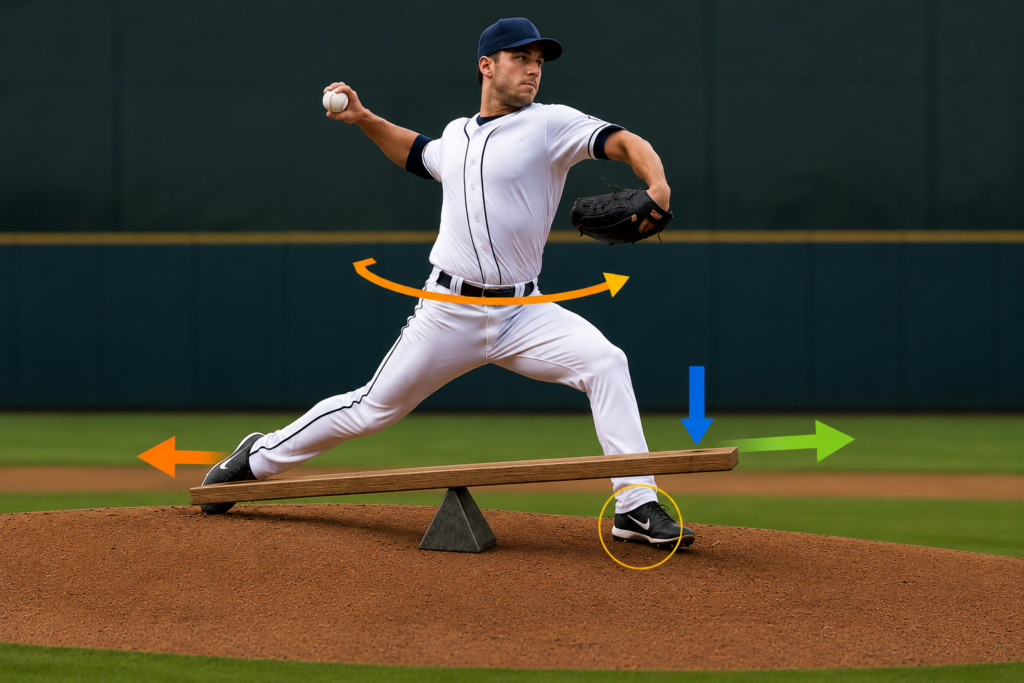
I chose the word leverage for this section specifically because I believe it captures at its core what pitchers are trying to do between leg lift and foot plant. We’re not quite dealing with fulcrums and levers. Humans are omnidirectional movers; there is one “lever” that controls the throw. But the body does need leverage when it wants to throw something hard.
If the low man wins in football, the one who does the most with the least wins on the mound. Movement efficiency – maximizing output while minimizing caloric expenditure – is how the best separate themselves from the rest. Efficiency is achieved by working through positions where your body feels strong. Where you feel strong is where you have leverage.
That’s what this section is about.
If you could capture a still shot during the delivery with the most predictive value, it’s arguably where a pitcher lands. You get information about what happened prior, while also getting information about what is likely to happen next. It gives us a ton of information about where and how guys create leverage, making it the center point for this section. Guys don’t find positions for the sake of being in positions. They work from where they feel strong – even if they don’t quite get to where they are “strongest.”
There’s going to be some carry over between sections. How you first get into your back leg, for example, will impact how you rotate out of your back leg into foot plant. But there are ultimately a couple of critical transitions you need to nail to find leverage at foot strike.
I’ve centered on two:
- Back leg depth to back leg rotation
- Hip flexion to hip rotation
Of all the strategies to create leverage in the pitching delivery, rotation is the most effective. Loading and unloading the body in the transverse plane is a foundational skill when it comes to improving throwing capacity. Great throwers are great rotators. This skill starts at ground interface.
Everyone will require a different amount of hip flexion, abduction, or internal rotation in their back leg loading pattern. The best way to see if it works for you is by looking at how you unload the back leg. How the back leg moves out of max depth tells you everything you need to know about how you loaded it. If you jump out and extend early, for example, you likely loaded too far down. Your body’s natural reaction to flexion it can’t handle is extension. If the back leg never rotates, on the other hand, you likely need to add some hip flexion. You didn’t actually engage the back leg in a way where rotation became a reasonable option for your body.
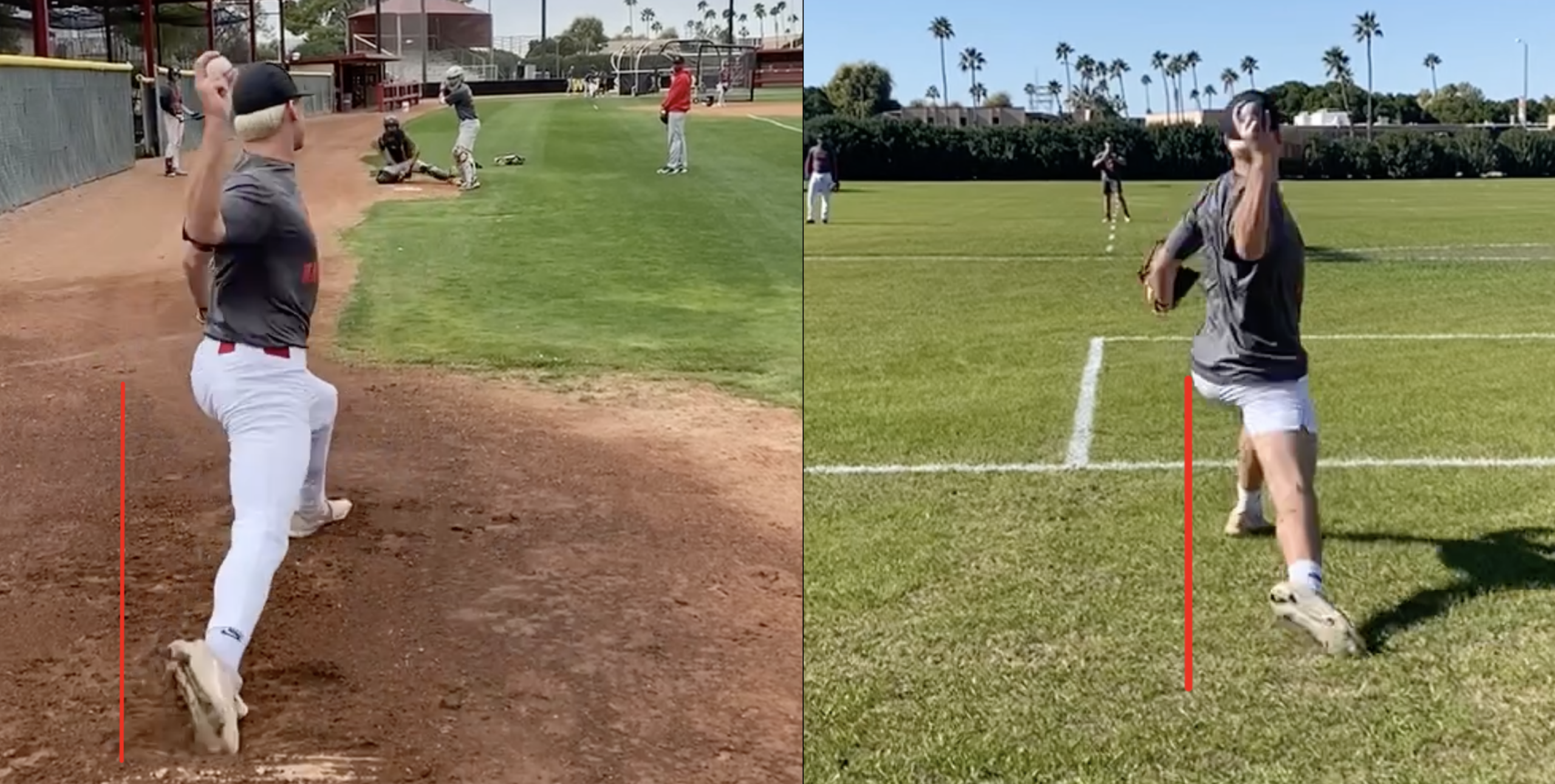
When the back leg rotates, the hips should hold and stabilize in the sagittal plane of motion (e.g. hip flexion/extension). You can see this from the back by putting a line on the back of the rear glute at max depth. If the rear glute moves inside that line, the hips have extended prematurely – negatively impacting hip to shoulder separation. You can always rotate into extension, but you can’t quite extend your way back into rotation. If the rear glute moves outside of that line, the hips have dumped or “bailed” (e.g. think hitter who bails off the plate). This forces the trunk to counter into unnecessary flexion, requiring large postural deviations downstream to get back into slot.

Internal rotation of the back leg sets up for the next movement in this sequence – hip flexion to hip rotation. When a pitcher has maximized femur on hip internal rotation, the hips should follow suit and begin to rotate independently of the chest. The degree to which this happens is highly dependent on each individual athlete (e.g. hip internal/external rotation bias). But being able to achieve some degree of hip to shoulder separation is a critical move in regard to rotational sequencing. It’s how the body picks up speed in this transverse plane.
A key component to creating this move is by stabilizing the lumbar spine. Whether you’re in flexion/extension or rotating, the lower back creates a stable platform to allow the hips and upper back to mobilize (think mobility stability continuum). If the lower back extends and mobilizes during the delivery, the hips and shoulders end up getting glued together. They move and turn at the same time to prevent from large separation gaps in extension-based postures. It saves your lower back, but ultimately comprises rotational sequencing.

How much hip to shoulder you achieve is heavily dependent on your hardware structure. Some guys with a bias for internal rotation or hip flexion have the capacity to dissociate their hips and chest in larger capacities over those who favor hip external rotation or extension. In either situation, both of these athletes can find hip to shoulder separation. One just needs a lot more than the other. If the hips turn before the chest does without the lower back extending, you’re right where you need to be. Trying to manufacture any more will hurt more than it will help.
…
The last two thoughts I’m going to touch on in this section are intertwined:
- Multiple points of leverage at foot strike
- Middle in the middle
Proximal to distal is a foundational concept for all human movement. Whether you’re walking, jumping, or swinging a baseball bat, what you do at the hips and chest has ripple effects outward on the body. When movement is at its most efficient, the extremities don’t operate as separate entities. They are slaves to actions in the middle. Rotation at the hips creates rotation at the legs. Movement at the chest creates movement at the arms. What’s closest to the body’s center of mass will always carry most influence over the body.
At the same time, holding on to leverage at the middle is how you create leverage at the extremities. In this case, more specifically, the legs. Torque is a lot easier to create when you have two points at ground interface to grab on to. When you jump off the rubber, you actively give up one of your two points of connection to the ground – making it a less efficient strategy from a leverage standpoint.
If the middle is centered between both legs when both feet find the ground again, the legs can anchor the body evenly from both sides. If the body is more heavily weighted towards one leg or the other, the opposing anchor point has to work that much harder to hold on to the ground. Hitters who hang too far on their back leg lose their ability to hit against their front side and spin. Pitchers who shift forward and land with excessive lead knee flexion lose connection to the rubber on their back side. If the middle shifts forward, the limbs get dragged with it.
With this, there is some variance in where guys like to feel their center of mass in relation to their legs. Certain guys will prefer feeling more “into” their back leg or front leg when it’s time to turn. It’s preference over principle. If the center of your body is anchored in at two different points when it’s time to turn, you’re likely right where you need to be. If you can’t do that, something prior in the sequence needs adjusting. Sometimes it’s in the positions, other times it’s in the transitions.
Both require coaching.
…
Rotating is one of those things that’s innate until it’s not. Turning your hips and chest are normal preferences for your body to choose when you make a throw. That is, until you spend time and conscious energy on things that promote the opposite – reaching for the sky, bending over to finish your pitch, pushing off the mound. Kids who spent their younger years trying to throw the hell out of things know how to rotate their hips. I, on the other hand, spent a lot of time in balance points doing rocker drills. There were certain things I trained myself out of when I was young that I had to re-teach myself when I started to throw again.
The problem is quality hip rotation isn’t as simple as just trying to rotate your hips more. If you don’t have the capacity for a large degree of hip to shoulder separation, more hip rotation will peel your body too far open. There’s a sequence of events that transforms hip rotation into a catalyst for good throwing.
Part of it starts with good starting positions. For example, it’s a lot easier to rotate your back leg from hip flexion over hip extension. Your femur has more room to turn. Part of it is more software-based. If you were taught to push off the rubber to throw hard, you probably developed a bias for knee/hip extension over hip rotation. Rewiring that software pattern isn’t a simple fix. Extending your back leg will probably feel a lot stronger than rotating your back leg when you first try. It doesn’t mean you’re working on the wrong thing. It just means overriding faulty software takes time.
The main problems I tried to solve in this area were pushing out of my back leg and shifting forward at the middle. I’d wind up with a lot of weight and flexion on my front side, causing my back side to get disconnected from the rubber. A lot of the stuff I did growing up was very linear – push off the rubber, reach out to finish your pitch. It helped me throw strikes, but at the expense of some rotational capacity.
Like I said, rotating is innate until it’s not.
Below are some of the drills I tried:
- Split stance throws (left foot and right foot in front)
- Wide base throws (baseball & waterbag)
- Rotation into foot plant (Waterbag, PVC)
- Lead leg pulses (Waterbag)
- Walk in throws
- Step behind throws
- Single hop PVC turns (mound)
- Waterbag/ball pitches
The split stance throws were designed to attack the folding/shifting at my chest. I used right foot forward to create a barrier to folding/shifting. I used left foot forward when I wanted something that felt closer to a normal throw. I did have to modify these after a while because I felt I was pre-setting in too much lead knee flexion. I used the rotation of my torso to initiate hand break, almost trying to take my arms out of the equation. Loose and close helped them stay more connected to my chest.
My next step was to figure out my two points of leverage at foot strike. This lead me to the wide base movements. I wanted to map out where I wanted to get to before I got there. I started off with minimal pelvic rotation, trying to emphasize connection to the ground in two different places. The water implements were great for magnifying feedback here.
With my hips having an external bias, I had to utilize a more neutral stride direction with my feet oriented pointing out to buy my hips some space for internal rotation. There was a point where I used some toe in moves on the back side to emphasis hip on femur rotation into my back leg, but those variations had a short shelf life because of how difficult it was to hold the ground from that position.
The throwing variation I felt was most useful from a wise base constraint was when I added a small step. I got the idea from my good coaching friend Wes McGuire. The constraint of the wide base was really uncomfortable at first. I felt like I had no room for error with how I moved (part of this was the length of my old arm action). After a while, I learned how to leverage the added tension to make my upper half a lot more efficient. I could kill some tension and shorten my arm up without feeling pushy. I learned how to use hip on femur internal rotation to initiate leg lift or shifting and swaying into my back side. Sometimes it got a little too counter rotated. But it was so much easier to keep my center of mass in between my legs by simply starting closer to where I wanted to land.
The walk in throw variations I implemented were a little more hip friendly over roll ins for my body. I don’t have a ton of hip internal at my disposal if I try to force toes pointed towards my target. I fly open. Instead, I kept them angled closer to 45 degrees. While some of my earlier throwing variations were done from a point of minimal pelvic rotation, I did need to feel what it was like for my hips to be more “open.” I don’t love the word open because the pelvis does need to stay closed to maintain a point of leverage on the back side (think about how you’d position yourself to rotate 100 lbs. on a cable machine). But the hips do need to rotate to create space for the lead leg to block.
While this drill was how I cheated to get there, I started to put it together from my actual delivery when I put my focus into rotating the front side into the ground. This unlock came courtesy of another of my good coaching friends Jared Wilson. He had been reading up on a Japanese pitching concept where they try to “corkscrew” the front foot into the ground. I had heard of the concept in regard to the back leg. Never the front. I had tried out some lead leg specific cues in the past in regard to my baseball swing. I found at times it was a lot easier to load my back leg when I thought about loading it from the front (think Ted Williams knee to knee move). I tried it out on the mound and immediately had success with it. It almost felt like I was opening my body too early, but in reality it was just preventing my hips from closing off too much.
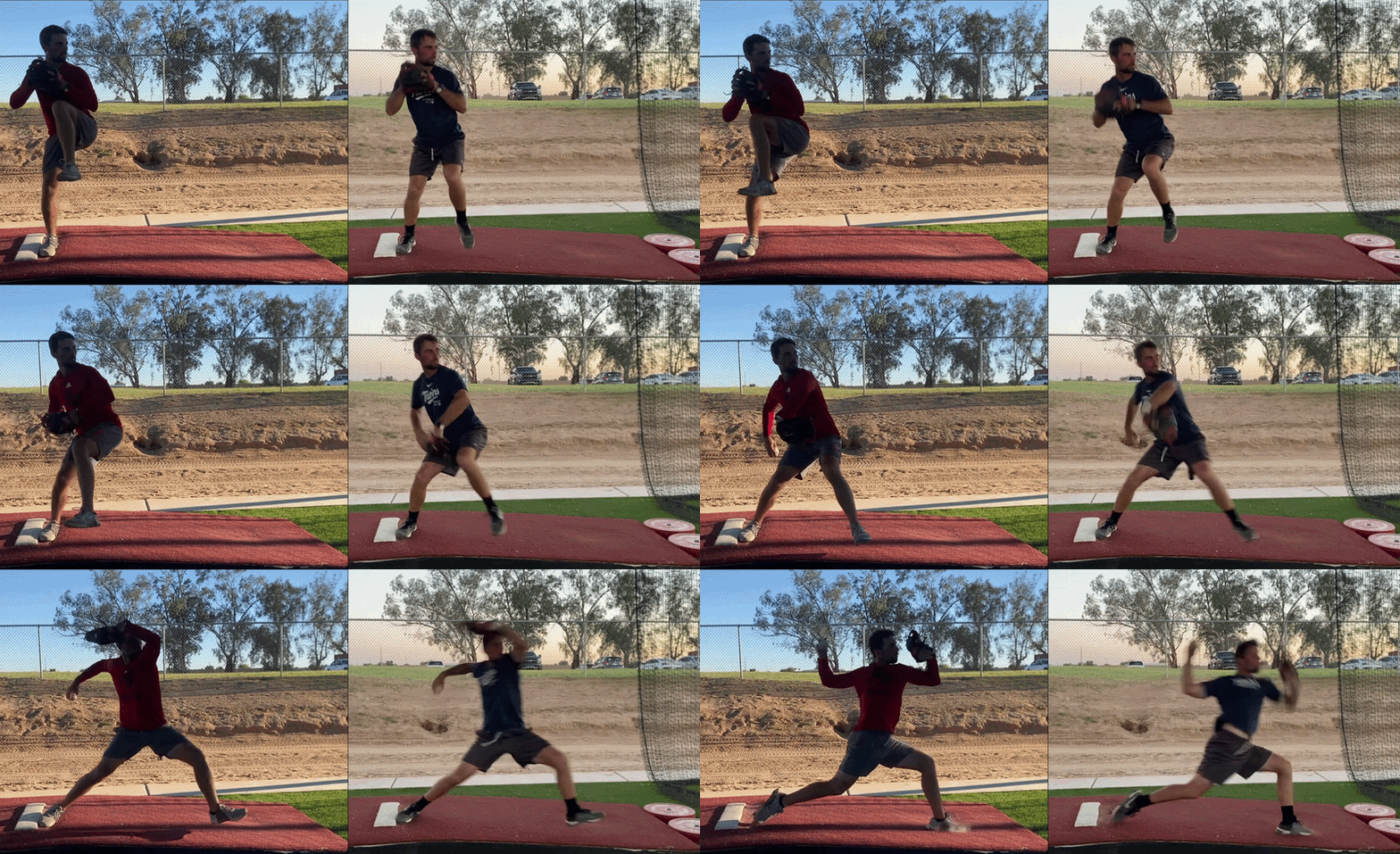
This move was tough to think about consistently during the course of the throw, so I designed a couple of drills in my movement prep – as seen below. My focus had to be on the front side. When I was focused on unloading from the back leg, I didn’t create enough rotation into foot plant. I’d end up too closed. I also played around with some Tom House-style football throws. I don’t love how those are often executed, but I did feel the exaggeration of rotating my hips into foot strike was a healthy balance from how I had been throwing for a long time (zero hip shoulder).
The biggest source of feedback for this ended up actually being my chest. If I folded and got really linear during my throw, I knew I didn’t create enough hip rotation into foot strike. Sometimes it got too open/spinny and everything would go way too early. But if I could feel my chest turn to make a throw, I knew I was in a better spot with how my hips were moving. Good hips are often the foundation for good chest mechanics. It doesn’t mean you’re always going to move better up top if you move better down low.
But it is pretty tough to “out-chest” bad hips.
…
The step behind throws were how I created some back leg rotation when I stretched it out and saw some ball flight. But this unlock was less about the drill and more about the feedback loops I hadn’t been utilizing. I did a lot of throwing into a net early on. One, because I didn’t have a throwing partner. But two, I really wanted some space where I could focus on how my body was moving.
Taking away ball flight at first helped me do that. I could hone in on specific parts of my delivery without the consequences of also making an accurate throw (not saying these skills operate in isolation). What ended up hurting me after a while was my inability to turn my brain off. I spent way too much time thinking my way through each movement instead of trusting my training and letting better movement emerge with consistent and deliberate work.
To get out of this loop of perfecting every detail, I started incorporating long toss. After doing a select number of drills into a net (was more focused on how certain things felt over ball flight), I’d grab a bucket of balls and stretch it out on the field. The intensity was relatively light at first. After a while, I picked it up and tried to put some pace on the ball when I started to reach my max for the day. If things still felt good, I would work back in on a line keeping the intensity higher.
I loved long tossing as a player, but I was working from a different set of mechanics now. I wasn’t able to stretch it out the way I used to. When I tried to cheat and gain additional distance, I’d revert back to things I didn’t want to do anymore – longer arm path, folding, excessive momentum. It made me appreciate how long toss is one of those things you need to customize to you. Gamifying how far you throw causes you to spend time working on a skill that is very different from pitching off of a mound. You create conflicting points of leverage.
And if you play stupid games, you win stupid prizes.