

If there’s an inefficiency in the delivery, you can usually pin it back to some subset of bad rotation. Something either isn’t turning when it should (e.g. pushing), or it’s turning when it shouldn’t (e.g. spinning). Of all the style involved in a throw, rotation is the one thing that unites us all. It might look different player to player, but there are principles that govern a lot of different interactions within the throw. Finding the substance behind those interactions is what this piece will focus on.
I like to break down rotation into two main buckets:
- Rotation of the Body
- Rotation of the Arm
The three things I like to look at in regard to rotation of the body are as follows:
- Front leg stabilizes and prevents shifting, lateral deviations during hip rotation
When the front foot finds the ground again, the front leg has to stick and stabilize in multiple directions. It can’t shift forward, cave medially, or wobble laterally. The combination of the front leg pushing into the ground and backwards is what helps create the braking forces required for deceleration of the lower half. Any instability here makes that process much more difficult.
- Hips decelerate and create platform for acceleration of torso
The interaction between the hips and torso is the meat and potatoes of this section. The two work together the way you’d crack a whip – one must stop for the other to go. In this case, stopping of the hips creates a slingshot effect to accelerate the torso. Sometimes, the fix comes from increasing lower half stability. Other times, the fix can actually come from improving torso rotation. It’s not a block then turn – you turn into your block. Sequencing tells us one thing must happen before the other, but how you improve sequencing largely depends on your ability to get different segments to cooperate. These two segments must be able to cooperate in a high level throwing sequence.
- Chest and hips rotate around shared plane of rotation
Just the way the arm and chest need a shared plane of rotation (more on this below), the hips and chest also need to mirror each other. The hips can’t rotate like a merry-go-round (east to west) while the chest rotates like a ferris wheel (north to south). They need a common denominator. Guys with higher slots will organize around more vertical planes of rotation. Lower slots will do better creating force from more horizontal planes of rotation. This cooperation can be observed during the block. If the front hip caves laterally, for example, the chest and/or hips need to interact with the ground more vertically. Below be an example of the opposite.
The two things I like to look at in regard to rotation of the arm are:
- Chest delivers arm around shared plane of rotation
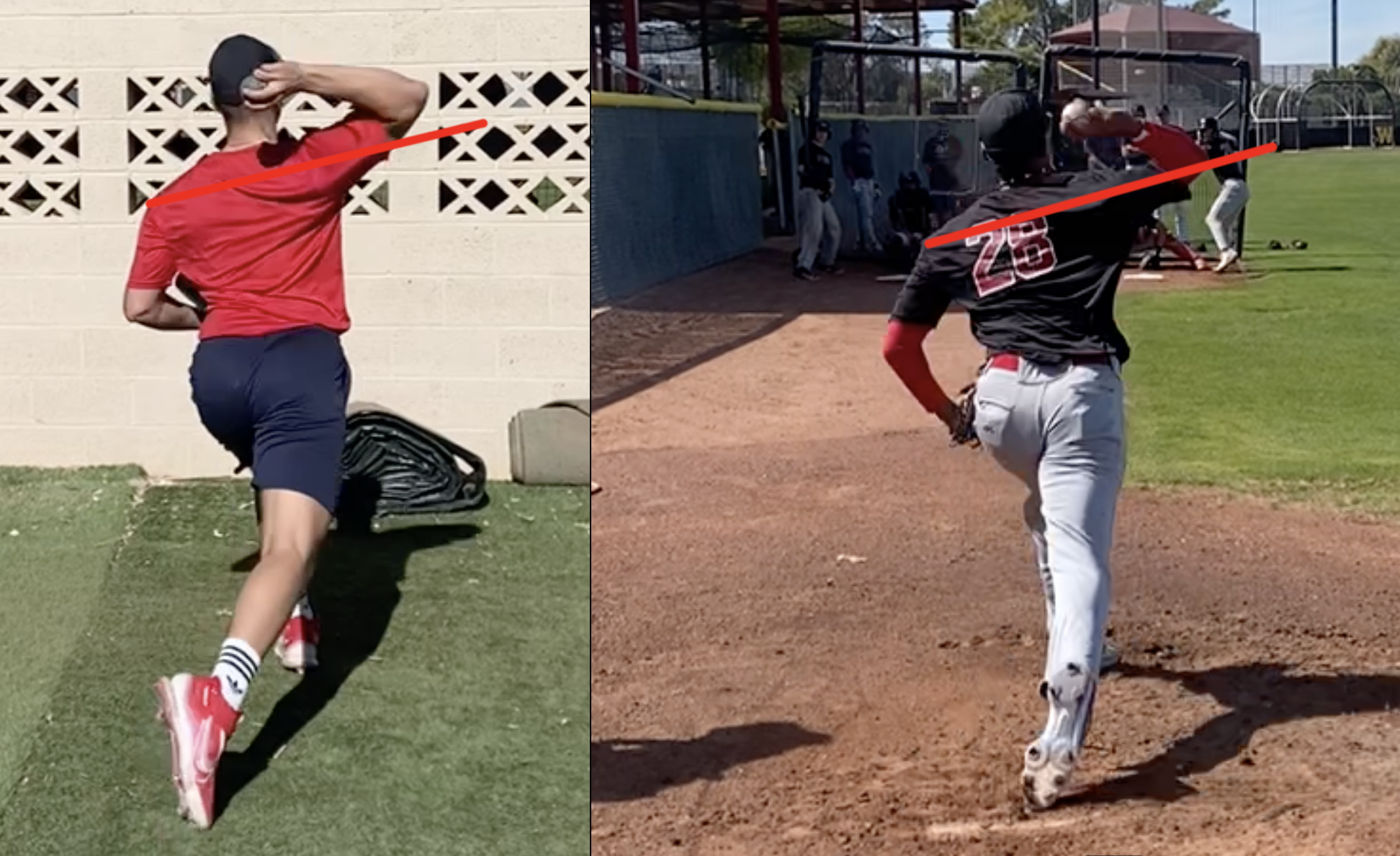
If you’ve ever dropped a guy’s slot and their arm immediately felt better, you likely matched planes of rotation between their chest and arm. Everyone has a preferred style for how their torso needs to rotate. Some guys need more thoracic extension (higher slots). Others need less (lower slots). Wherever the shoulders line up is where the arm needs to unwind from. Ideally, the shoulders, throwing elbow, and throwing hand will all align along the shoulder line into release. Any movement where the elbow climbs above or below that line, for example, would be an undesired movement. Sometimes the arm doesn’t match the chest. Other times, the chest doesn’t match the arm (more on this below).
- Safe dissipation of energy post release
Post release, the throwing shoulder and forearm are going to get married into shoulder internal rotation and forearm pronation. This helps decelerate the throwing arm and distribute stress among muscles in the forearm, posterior shoulder, lat, and other surrounding musculature. Any sort of distal elbow extension or forearm supination can create a break in this pattern, creating situations where the elbow or shoulder can take on more stress than it can handle.
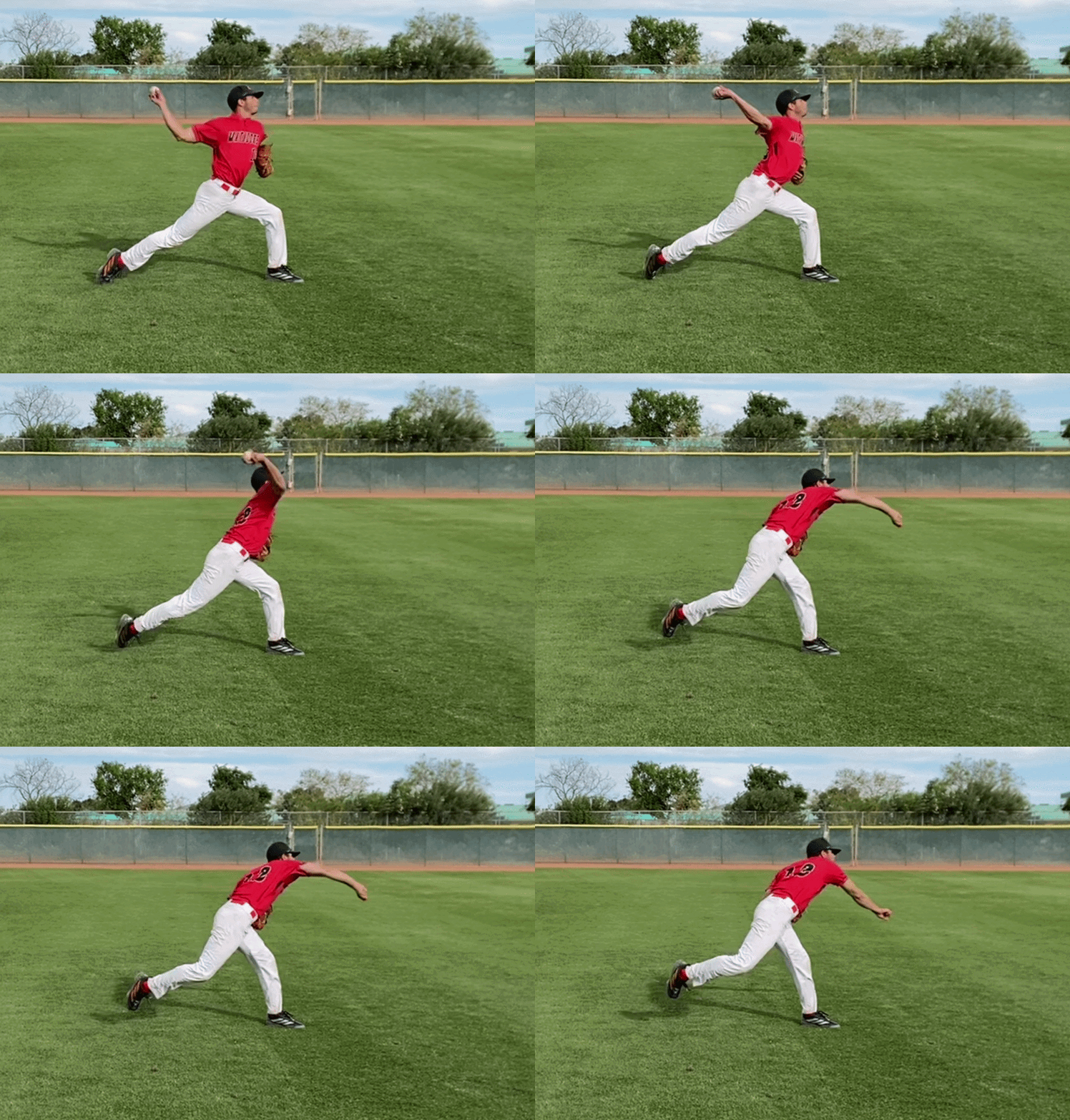
Some of the breakdowns in this section require an understanding of what happened prior. Hips that don’t rotate into foot strike will create barriers to torso rotation. Back legs that push and lose the ground early create poor blocks. It doesn’t mean things have to be perfect to this point in time. You can save a bad back leg with an A+ block. But if you have a bad block, it’s not always your lead leg’s fault.
There’s going to be plenty of residue in this section from prior posts. As detailed in section two, there were things I was able to accomplish with my lower half that helped clean up the rotation of my torso. A lot of my findings in this specific section will detail my experiences figuring out rotation of the arm. There are things I did with my body that allowed for specific changes with my arm action, as I’ll elaborate on. But how the arm moves itself is really important. When the arm moves well, you don’t have to worry about saving your bullets.
You can build more.
…
I’ve always had a longer arm action going back to my younger days. Some of it was likely a byproduct of coaching – “reach for your thigh, show it to the sky.” Some of it was residue from my obsession watching Tim Lincecum’s mechanics. I was also coached to throw a lot of strikes, which helped me build mechanics great for strike throwing. Not necessarily for throwing hard.
I started to learn in college about how it’s actually more efficient to get into positions where your arm is more proximal to your chest. I struggled to get my arm to the “90/90” relationship at foot strike (forearm to humerus, humerus to torso). What I learned, however, is it’s not so easy to go from a long arm action to a short one. Robbie Ray was a great example of this back during the shortened 2020 season. He shortened his arm action and started throwing harder (92.5 mph to 93.7 mph), but his command went to hell (17.9% BB).
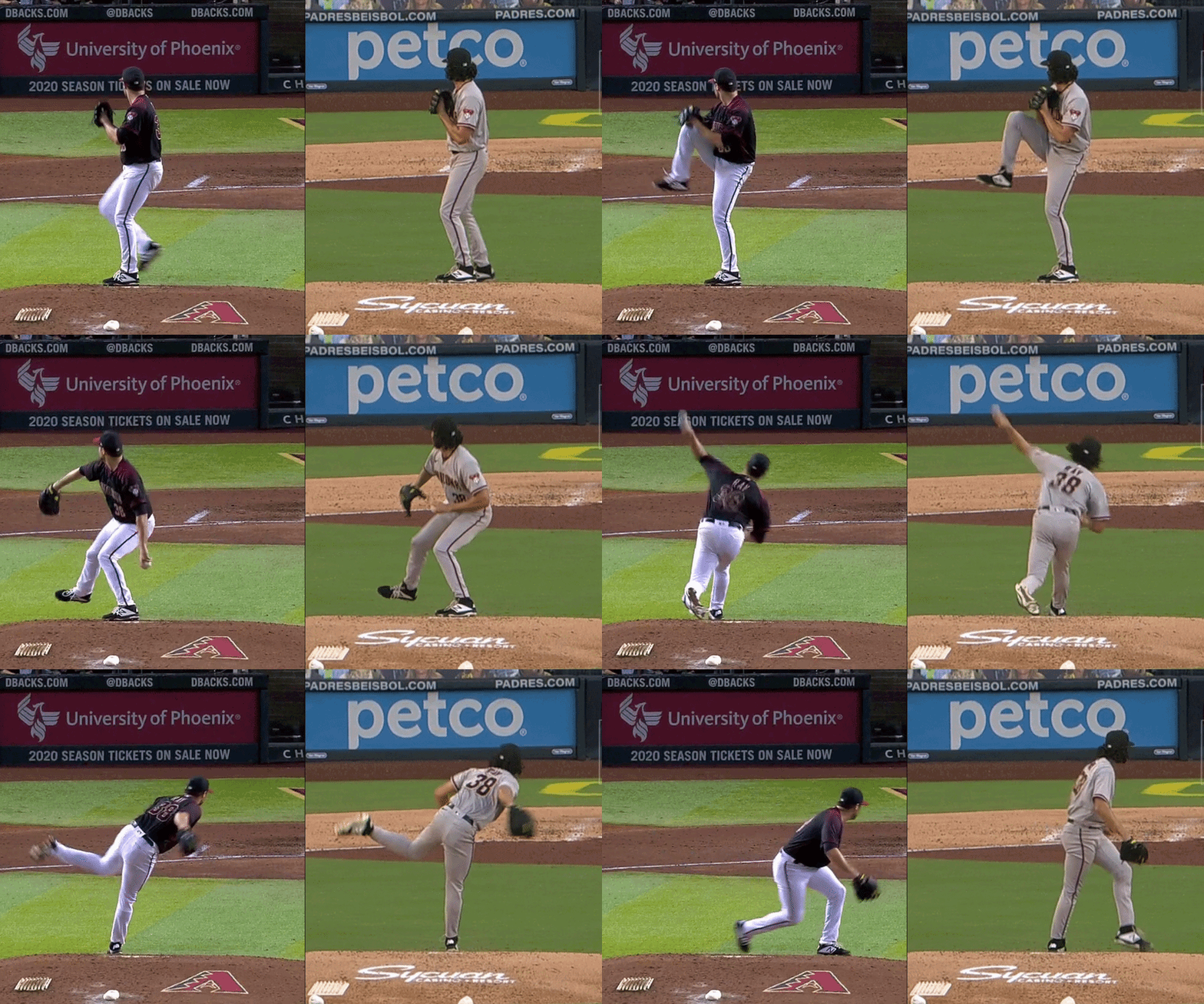
When I tried to shorten my arm, I struggled to get it to sync up with my body early on. If my body was a boat and my arm was a raft tied to the boat, the boat was trying to take off full speed with slack still in the rope. My arm wasn’t dragging behind my torso anymore, but it couldn’t functionally work better because it wasn’t synced up with my torso. There was still slack in the rope when it was time to turn. It’s one thing to create less movement. It’s another to create connected movement.
One of the first things I tried was getting a baseball out of my hand. With time and practice, you start to build learned associations between movements and implements. Introducing a new implement represents a blank slate for your body. If you’ve never thrown a club before, your body doesn’t have a movement strategy to default to. It’s forced to explore something more efficient for the new task – the key to introducing a new movement change.
I relied on two daily staples in my pre-throwing block to start to break some old habits:
- Reverse Marshall throws with Throwing Sock
- Football
The throwing sock is something I first got exposure to when I was at the Florida Baseball ARMory. I spent a lot of time at 108 Performance trying to achieve a deep “trunk capture” (arm lays back into external rotation during rotation of the torso). I ended up finding positions that were too deep over time, making it tough to relax and kill tension in my arm. Because I wasted a lot of my arm path behind my body, I struggled to release the ball out in front consistently – what you need to make the crisp “pop” sound after a quality sock throw.
Because my torso has the tendency to shift and fold, reverse marshalls were the perfect way to introduce a loading pattern that relied more on rotation. This ended up having an immediate impact on my arm action. I didn’t have the time or space to reach back the way I learned to watching Tim Lincecum. My arm had to get up a little cleaner and sooner to sync up with the rotation of my torso. This ended up creating the “trunk capture” I desired at 108, but not by forcing external rotation. More so by creating space where it could naturally happen.
Football catch play ended up being my choice for an overload implement. My body has always handled heavier implements better over lighter implements. It’s a more natural way for my body to remove slack in my arm without really thinking about it. I warmed up daily with a ten ounce baseball my last two seasons of college. It had this way of letting me know whether my body was synced up or not, especially when I went back to a five ounce baseball. If I spiked the first five ounce throw, I knew I was using too much arm.
The thing about the football I liked over normal weighted baseball catch play was how it naturally encouraged shorter actions. I found it a lot tougher to “cheat” a good football throw, probably for a number of reasons – the size of the ball, weight, the objective (throwing a spiral), tempo. There’s something about having a football in your hand that gets you to feel and move more athletically. Most baseball players don’t have a background where they’ve been coached to throw a football “properly.” They just try to throw a spiral and adjust based on the feedback they get throw to throw. More times than not, this promotes really good movement.
Some of the movements I tried with a football included:
- Walk back throws
- Walk forward throws
- Three step drop backs
- One step drop back
- Roll left
- Roll right
I would alter which drills I picked from this progression based on how I was feeling that day. If I felt slow, I did some athletic drills to speed things up. If I felt good and wanted to let some loose, I did some longer drop backs and thought about throwing a go route. The biggest thing was just making sure my arm and body were connected when I ramped the intensity up. I commonly had to exaggerate the rotation of my torso (loading and unloading) to make sure I wasn’t shifting forward and pushing.
Putting it altogether with a baseball required some changes, but less with the actual path of my arm. With some experimentation, I discovered my arm action worked a lot better when I tried to keep my hands as close to my torso for as long as possible. It was a really big adjustment at first, but once I leaned into it I couldn’t believe how much simpler my arm action became. This ended up getting me to rethink a lot in regard to the extremities and where they need to be in relation to the body at certain points in the delivery. Some need them further away (more space). Others, like myself, need them much closer.
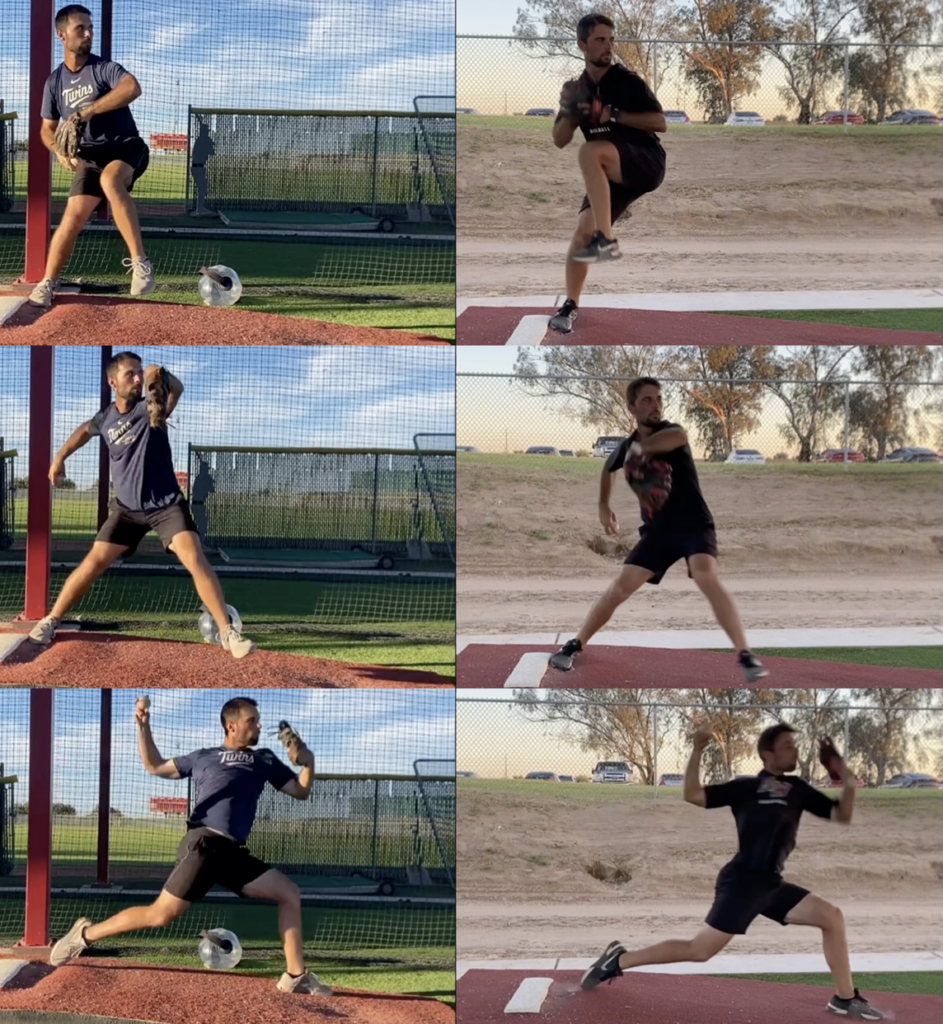
The last piece that started to put everything together was re-evaluating my arm slot. Concepts like slot and matching planes of rotation were things I never thought of as a player. I just liked long tossing, so I naturally added some tilt and worked from a higher slot. When I started to learn more about the relationship between the chest and arm in the throw, I experimented throwing from a lower slot.
What I ended up learning was the thought of a lower slot helped me learn how to rotate my torso better. I really had to feel the center of my body turn to deliver my arm. This is a big reason why I believe dropping slots can work for certain guys. You have to rotate better to make it work. All you’re doing is positioning the arm in a plane of rotation that works better for the torso. Where you throw from doesn’t dictate how well you rotate, but you have to rotate wherever you choose to throw from.
I didn’t have one realization I was working from too low of a slot. I just put a lot of clues together – tension, spacing, ball flight, previous experiences. My biggest movement flaw was shifting forward at the middle and folding, causing my arm to get stuck and lost behind my body. I found a temporary solution by holding torso counter rotation for longer, dabbling with taking my eyes off my target. It helped give my arm space and time to unwind into a good position at foot strike, but the expense of some direction (too across, spinny).
When I started to incorporate long toss back in again, I started to play around with adding some shoulder tilt again. I had worked really hard to eliminate unnecessary pelvic tilt. It was a really important adjustment at first, but over time things got too flat too fast. Your hips should tilt when you get into your back leg. The chest should mirror this tilt. Mine were not, which ultimately was causing the shifting forward at the middle of my body. I’d get too flat too fast, so my body would have to shift forward to buy time to get my arm up.
Once I started to think higher again in my delivery, everything made so much more sense. I finally had some thoracic extension to create some room for my arm to work. I stopped spinning on my front side. I felt like I had more time to work. It wasn’t such a rush job to get my arm up anymore. Ultimately, I took all the work I did remapping my body, shortening my arm, and put it together from a slot that was more natural for how I move.
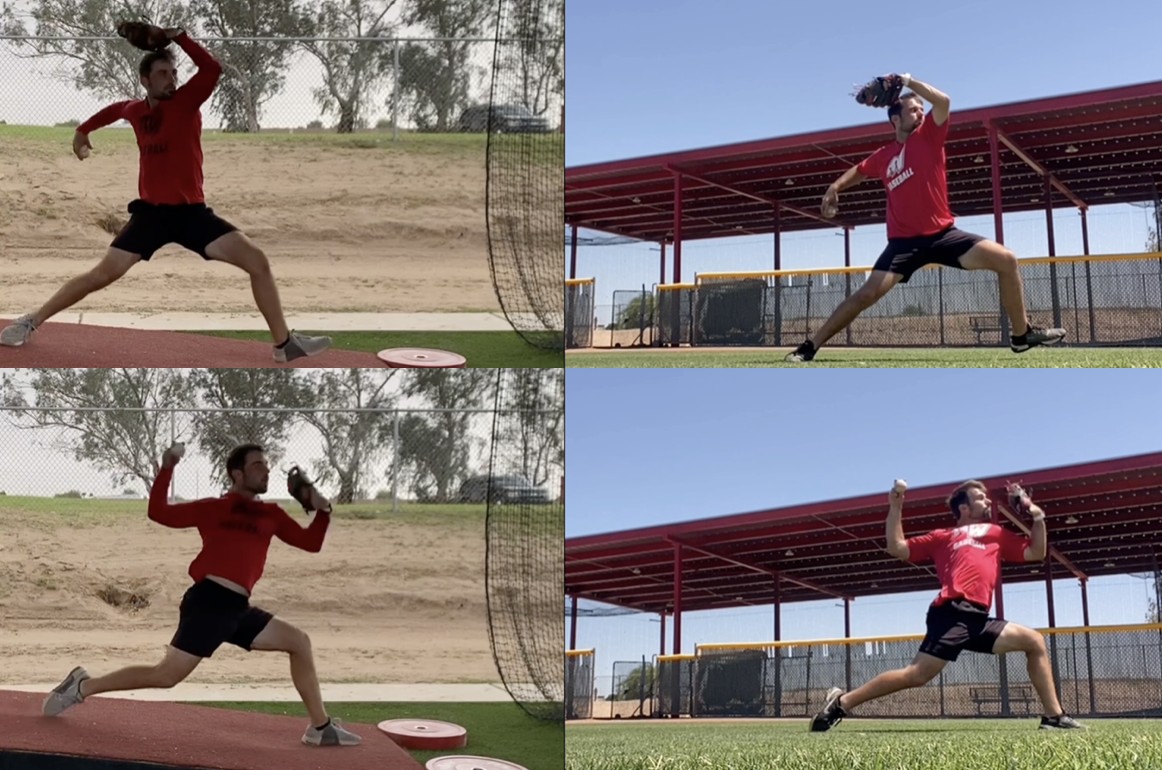
I didn’t necessarily change my arm angle a ton. I just changed the positioning of my torso so I could match the angle of my arm. This is the concept behind sharing planes of rotation between the arm and torso. Everyone has a preference on how and where they need to rotate from. Sometimes you need to match the arm to the chest, other times you need to match the chest to the arm. They just need to match – arm angle be damned.
…
The origin of this three-part series ultimately started as a way to starve off boredom. At the time, I was a little over a month into my job at Arizona Western. I had moved back across the country from Florida, packing only what my Kia Soul would allow. I was living on campus with two other coaches on a small cottage just outside of the dorms. I was making the worst money I ever had in baseball, four months after finishing up my first season in professional baseball. There was nothing to do in Yuma. I haven’t had too many bad days as a coach. I sure didn’t have too many good ones that first month in Arizona.
In professional baseball, it always felt like there was something you could be doing. There was video to watch, statistics to evaluate, pitchers to scout, theories to test. Junior College was a little different. Outside of some recruiting here and there, I didn’t have a lot of stuff to do after 4-4:30 PM every day. It felt like the perfect time to start throwing again.
I’ve always learned best by doing. I can’t just understand things by watching presentations or reading blogs. I have to grapple with those ideas, stress test them, and put them into my own words. I wasn’t going to survive in Yuma if I spent my free time rotting away playing Call of Duty and watching Sabres games in the evenings. I needed to find something that would get my creative juices flowing again. Carving out time to throw every day ended up being exactly what I needed.
I decided my throwing sessions weren’t just going to be pure creative exploration. I wanted to build out a program for myself. At first, I dabbled with a lot of different things. The stuff I liked, I kept. I didn’t have firm rules on what I needed to do. I only had theories and experiences on what my body responded to best. Little by little, what started as a passion product turned into a methodical plan – drill work, workload management, lifting. It was all calculated towards the three throwing days I had every week.
With something else to look forward to every day, I started to show up to work with a little more excitement. The end of the day was no longer a drag. It was my opportunity to get back into the lab and re-discover what made me fall in love with what I do. I’d pore over video in the evening for hours, scrolling back and forth to see specific changes. I’d see things that reminded me of problems I was working on with specific guys on our staff. I could connect certain dots and empathize with guys on specific issues because I was experiencing those things first hand.
It’s not to say every day became a breakthrough. I had plenty of days where I’d be walking back across campus fuming because I didn’t like my focus or I got too distracted chasing a detail in my delivery I found wasn’t that important. I didn’t always have solutions to the problems I was experiencing. It was hard to turn my brain off and stop thinking. All of the things my players were struggling with, I also struggled with. Just because you know more about throwing doesn’t mean it’s a lot easier to get better at throwing. It’s still very easy to get in your own way – as I found I often did. For all the ideas it generated, it was often a humbling experience.
What I also found, however, was the bad days create the good days. There is no magic in this process. Only consistent hard work done intentionally over a period of time. The needle doesn’t move as much as you think day to day. I had plenty of days where I finished up throwing and felt like I took steps backwards. But I ultimately needed those days. They taught me so much – patience, focus, commitment to my process. Things as coaches we’re constantly preaching, but are much harder to act on when we’re actually doing the thing.
For the few sickos who actually took the time to read this far into my series, that is the message I’d like to leave you on: What we do as coaches is not what people make it out to be. We are not synonymous with car mechanics – we don’t just fix things when they’re broken. Getting better at this thing requires consistent, daily investments. Those days are not all pretty. Some of them suck. Things don’t always feel great. Really good work takes a lot of time to shine. Sometimes you take two steps forward. Other times you take three steps back. But you only truly lose steps if you stop taking them – and that’s the beauty in this process. If you just stick to it, you’ll outwork the many who never had the resilience to see it through.
Don’t find your voice through someone else’s work. Do your own. Screw things up. Celebrate the little successes. Don’t let the day to day distract you from the bigger picture. Break the rules. Do what feels like you, even if it’s weird. Honestly, especially if it’s weird.
We’ll never reinvent this game, but that should never stop us from pushing to find better ways to train for it, prepare for it, and ultimately learn from it. If we can do that, our best work will always be ahead of us.
…
Images/Videos from The Athletic, Baseball Savant